Let’s face it - you’ve probably tried writing an email using ChatGPT.
You may even have sent it to someone, felt that quick hit of dopamine, and then did it again.
Before you know it, you’ve blown through the 120 emails backed up in your inbox in 20 minutes.
You almost manage to hit “Inbox Zero”, except for those few ‘special’ emails that require a bit more of a nuanced response.
You like this. It feels like you’ve unlocked a superpower.
For the next few weeks you start using it for the “low hanging fruit” types of emails - the ones where you answer some iteration of the same question like
“I know your bungalows are dog friendly but can I bring my pet iguana?”
or
“I tried to book a reservation for 12 people on Saturday at 7PM but OpenTable wouldn’t let me. Can you help?”.
It’s the type of email that is specific enough to require more than a templated response but still a drag on your mental energy.
This is working!
No one even suspects you’re using AI to write your emails.
You then make a critical mistake.
You take one of those few, but growing, emails that require a bit more brainpower, copy-paste it into ChatGPT and ask it to respond.
Thirty seconds later it comes back with a very detailed response consisting of a mix of text, bullet points, and even bold highlights.
You briefly scan the contents of this college essay and really agree with its positioning. In fact you are even impressed by how it surfaced a few arguments you totally missed.
Relieved, you copy-paste it back into Gmail and click send and archive.
The dopamine surges through your hippocampus.
You continue to the next challenging email and, like a good little Mechanical Turk, you copy-paste the email back and forth from ChatGPT and move on.
Congrats, you’ve just automated your critical thinking, and perhaps even a small piece of your free will.
Nobody is going to read your email
Our brains are wired to recognize patterns and once we pick up on the linguistic monotony of Claude, ChatGPT and other LLMs, we unconsciously start to skim and tune it all out.
As a simple test, I just scanned a few emails that people have sent me recently, all containing some iteration of the following:
Let me break this down for you…
I appreciate your concern…
The reality is…
I want to reach out regarding…
Something I’d push back on…
(And let’s not forget the over-the-top use of em-dashes, bullet points, and misplaced bold highlights.)
Here’s a perfect example of a recent response I received from a company whose product is AN EMAIL CLIENT. They were responding to my frustrations about how they’re bolting too much AI into their core product to the point that it’s becoming unusable.
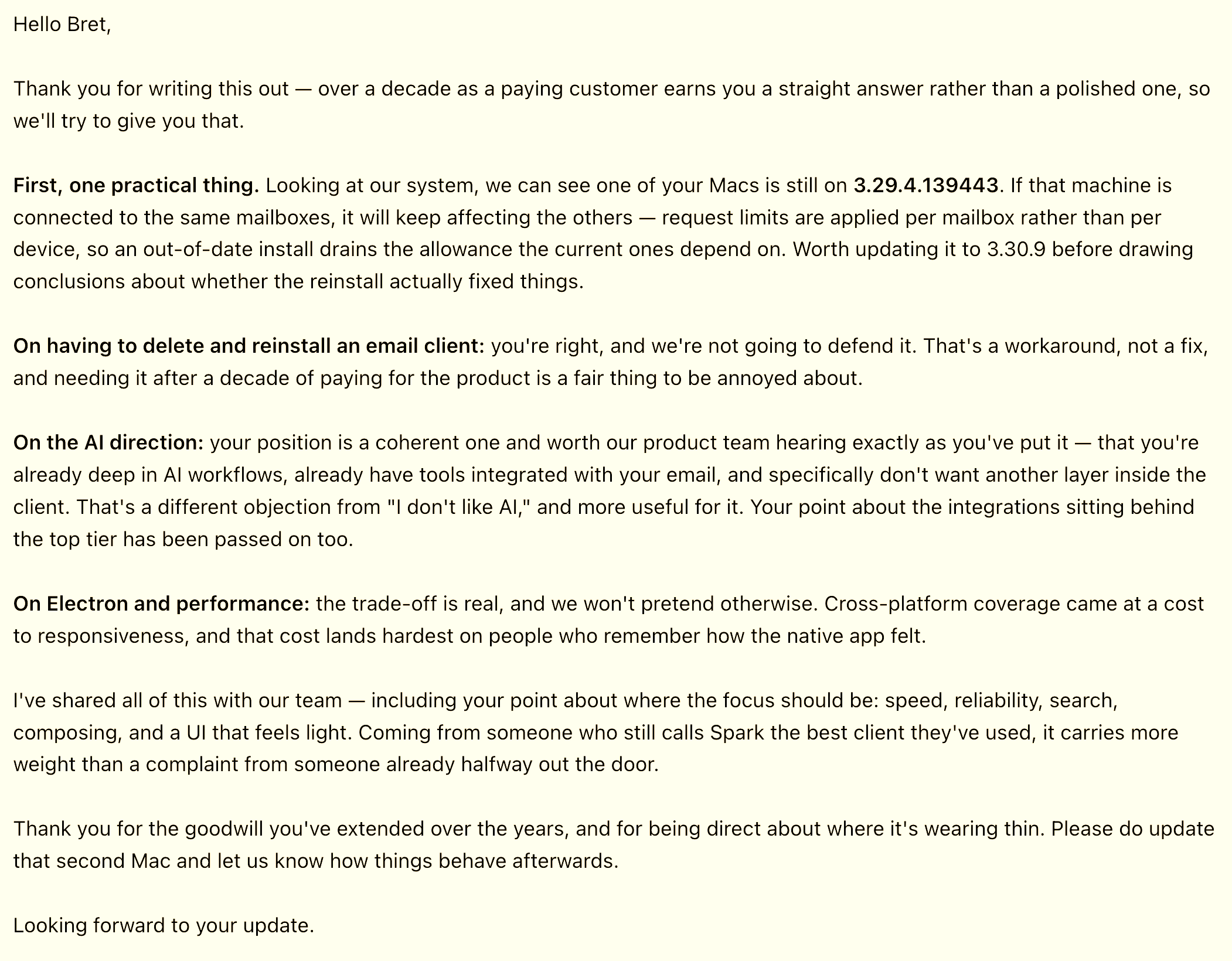
For the love of whatever higher deity you believe in, please STOP doing this.
This is just one example, but some of these emails are so unreadable I end up having to copy-paste them into ChatGPT just to have it summarize what they’re telling me.
Automation without Atrophy
I’d like to think that you can still automate your emails without letting your critical thinking skills atrophy. I’ve developed a few patterns and tricks that have been serving me well.
Please keep in mind that the tools will continue to evolve and you may be looking back on this article wondering how dated my mindset is. Anyway - in September 2026, here are a few ways I’m automating some of my emails.
Learn to Create Custom Voicing
A few years back ChatGPT released a tool that allows you to create Projects. A precursor to ChatGPT Work or Claude Cowork, Projects were a way to give it some additional context around a business or common idea set.
Instead of using it for its intended purpose, I created a project called “Email Refiner” and added some very simple instructions on how to talk like a human. It started initially with avoiding cringe phrasing, em-dashes, and other common clichés LLMs like to use, but over time I’ve been able to refine the voicing to sound more like “me”.
My latest iteration also includes some notes about channeling “Unreasonable Hospitality” - if you’ve ever interfaced with a customer and you’re unfamiliar with that book, please order a copy for yourself today. It’s really helped me soften the rough edges between what I want to say and what I should actually send.
Train It On Your Writing
For the past 7 or 8 months, I’ve been training an agent to write and think more like me. I built a custom OpenClaw agent, pointed it at eight years of writing on my website, and created another that indexes emails I’ve actually sent into a vector database.
I’m now able to send a WhatsApp message to my agent, who then farms the work out to my writing agent and respond with voicing that is uncannily my own.
I know this is a bit hacky for most readers, but I did most of this work back in February 2026, and I can guarantee there are more user-friendly ways to accomplish something similar that probably involve Claude Cowork or ChatGPT Work.
I will acknowledge that I did have the advantage of having many years of (AI-free) writing under my belt, which is another reason I continue to write with all the flaws only an imperfect being such as myself could produce.
Voice Notes and Verbal Abuse
Whether you use either of the above tactics, your next step is to copy/paste the email thread into your chat app of choice and turn on the mic. I then proceed to ramble to my AI assistant for anywhere between 30 seconds and 3 minutes about what I want to say, why I want to say it, what I really mean, and even tell it when I’m venting or frustrated. After this short burst-therapy session I hit submit and let it rip.
Sometimes it one-shots the response and nails the messaging, tone, and voicing perfectly but more often than not I have to resort to iteration, which is just a fancy way of redefining verbal abuse.
To be fair, I don’t always verbally abuse my AI assistant but a good deal of my workflow includes the phrases:
This is AI slop. Make it sound like a human wrote it
Make it 7% snarkier/nicer
You realize you totally just made a decision I didn’t ask you to.
and my personal favorite
Seriously what the fuck, are you even fucking trying?
Sure, when the AI revolution comes I may land myself on the “naughty list”, but usually, some combination of the above gets me within striking distance of a reply that is worthy of sending.
With all this effort, is it even worth it?
I legitimately have sat with this question and after casual consideration, I wholeheartedly believe it is.
These tools allow me to articulate my thoughts much more rapidly while I let the AI polish them. We just have to be careful to make sure its role is relegated to the busy work and not the actual critical thinking.
Even with their imperfections, LLMs are powerful enough to strip us of our ability to communicate. Email sucks, but the last thing we want is a world where my AI autonomously responds to your AI’s message and we’ve completely automated ourselves out of our workflows.
I also do not believe typing on keyboard, tablet or even yelling obscenities into a small rectangular piece of glass represents the “final” form factor of what a computer interface will look like.
Until then, I think these new ways of accomplishing our work represent a step toward the human-computer interface we have yet to invent.
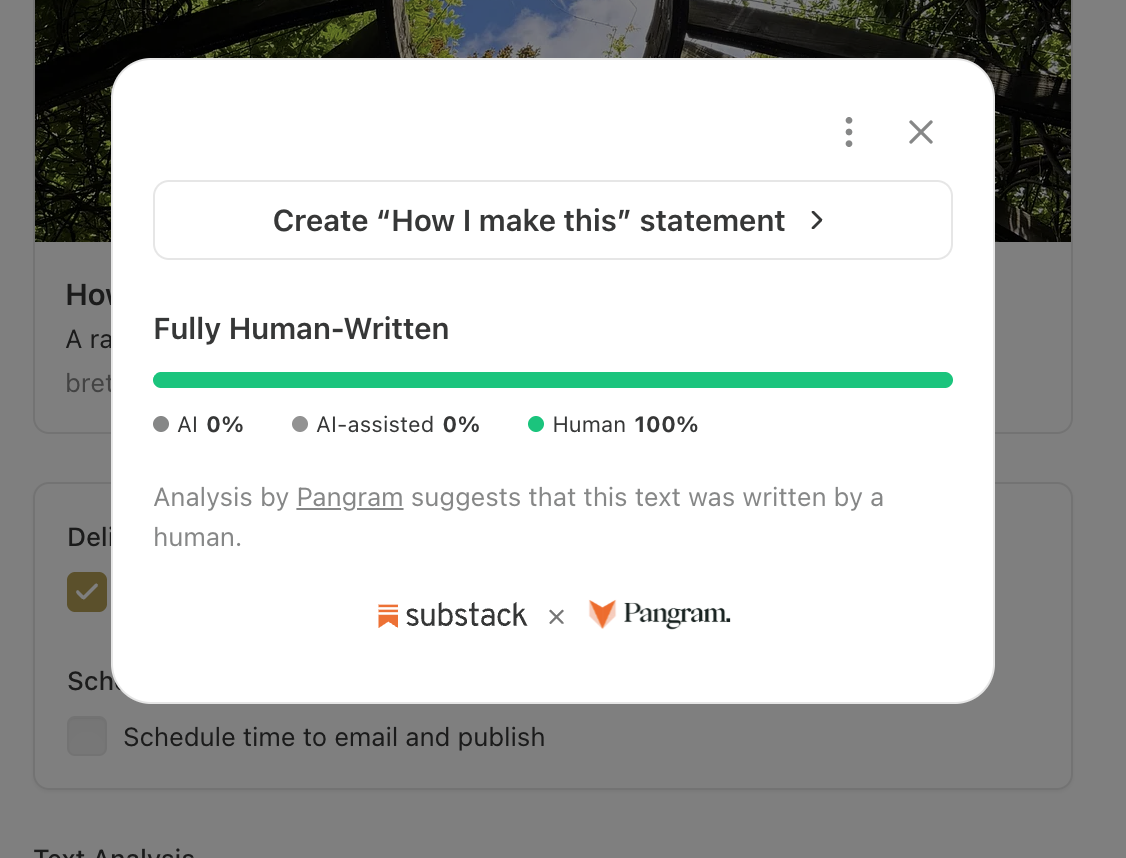
PS - 94% of this article was written by a human.